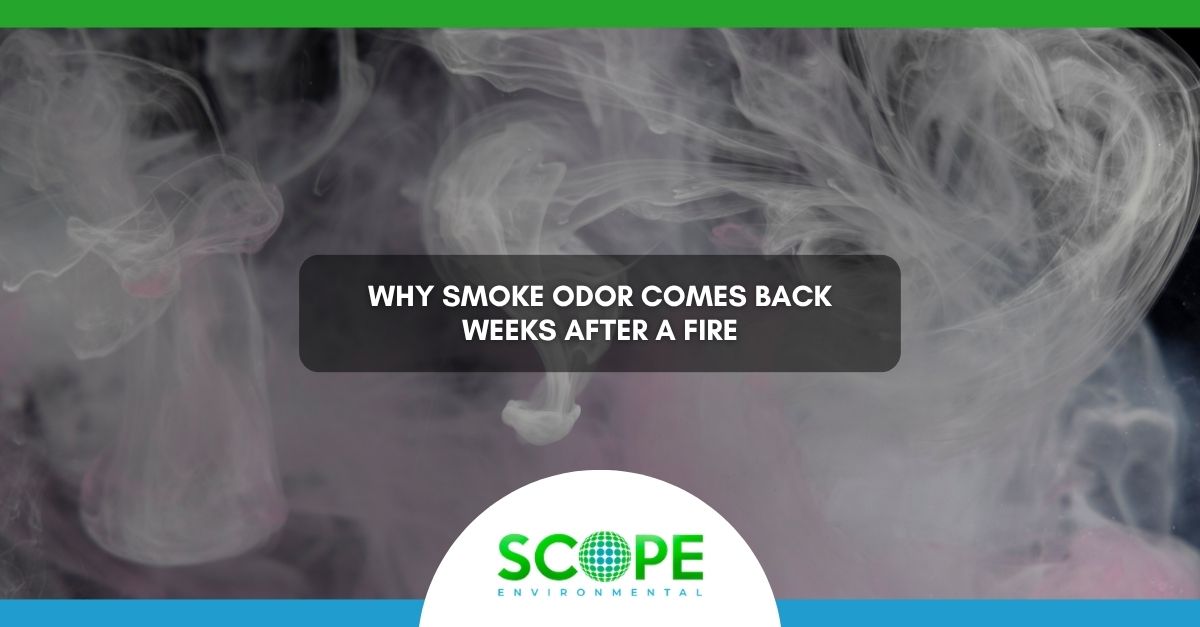
Smoke odor returns weeks after a fire because tiny smoke particles and soot settle deep inside porous materials—drywall, insulation, upholstery, and HVAC systems. Surface cleaning masks the smell temporarily, but heat, humidity, and airflow reactivate trapped odor molecules, bringing the smell back until the source is professionally removed and deodorized.
You cleaned up after the fire. The walls got wiped down, the carpets were shampooed, and the air finally smelled fresh again. Then, weeks later, that unmistakable smoky scent creeps back—stronger on humid days, lingering in certain rooms, refusing to leave.
If this sounds familiar, you’re not imagining it. Returning smoke odor is one of the most common and frustrating problems homeowners and business owners face after a fire. The smell isn’t “coming back” so much as it never fully left in the first place.
What causes smoke odor to return after a fire?
Smoke isn’t just visible haze. It’s made up of microscopic particles, oils, and gases produced when materials burn. During a fire, these particles travel with the heat and air currents, pushing into every crack, pore, and cavity they can reach.
When a fire burns, it creates pressure and heat that force smoke particles into porous materials. These particles are far too small to wipe away with a cloth. They embed themselves in surfaces you can’t easily reach, then slowly release odor over time—especially when conditions change.
Three factors commonly trigger the return of that smell:
- Heat: Warmer temperatures cause trapped odor molecules to become more active and airborne.
- Humidity: Moisture reactivates soot residue, making odors more noticeable on damp or rainy days.
- Airflow: Running your heating or air conditioning can circulate odor particles hidden in ducts and vents back into living spaces.
Where does smoke odor hide in a home or building?
Odor lingers because smoke reaches places that standard cleaning never touches. Understanding these hiding spots explains why a quick clean-up rarely solves the problem.
Porous building materials
Drywall, insulation, wood framing, and subflooring absorb smoke like a sponge. Even if the surface looks and smells clean, the material underneath can hold odor for months. As these materials warm up or take on moisture, they release the smell back into the air.
Upholstered furniture and soft furnishings
Sofas, mattresses, curtains, and carpets trap smoke particles deep in their fibers. Vacuuming and surface cleaning only remove what sits on top. The odor buried within the padding and backing stays put until the item is thoroughly deodorized or restored.
HVAC systems and ductwork
Your heating and cooling system can be the single biggest reason smoke smells return. Smoke pulled into the ducts during a fire settles on interior surfaces and filters. Every time the system runs, it recirculates that odor throughout the entire property.
Hidden cavities and hard surfaces
Wall cavities, attic spaces, and gaps behind cabinetry collect smoke residue that’s nearly impossible to reach without proper equipment. Even hard furnishings like desks, tables, and credenzas absorb odor into their finishes and joints.
Why does surface cleaning fail to remove smoke odor?
Wiping down walls and shampooing carpets addresses what you can see and touch—but smoke damage is mostly what you can’t. Air fresheners and scented products make the problem worse by layering fragrance over odor rather than removing the source.
The real issue is that smoke and soot bond chemically to surfaces. Removing them requires the right combination of cleaning agents, specialized equipment, and deodorizing techniques that reach beyond the surface. Without that, you’re only treating the symptom.
Choose professional restoration if the smell keeps returning, covers multiple rooms, or came from anything more than a very minor incident. A quick DIY clean may be enough for a small contained event, but recurring odor is a clear sign the source hasn’t been fully addressed.
How do professionals permanently remove smoke odor?
Professional smoke and soot removal targets the source rather than the symptom. The process combines deep cleaning, deodorizing, and restoration to eliminate odor at every level.
Scope Environmental professionally removes smoke and soot from upholstered furnishings, carpets, draperies, and building interiors. The team cleans, deodorizes, refinishes, and restores hard furnishings such as desks, tables, and credenzas—work that draws on years of experience with both residential and industrial smoke damage restoration.
A thorough restoration typically involves:
- Assessment: Identifying where smoke and soot have penetrated, including hidden areas.
- Deep cleaning: Removing soot and residue from surfaces, furnishings, and building materials.
- Deodorizing: Neutralizing odor molecules at their source rather than masking them.
- Restoration: Refinishing and restoring hard furnishings and interiors to pre-fire condition.
This approach matters because partial treatment almost always leads to returning odors. Addressing every affected surface and material is the only reliable way to stop the smell for good.
Stop smoke odor before it comes back
Returning smoke odor is a signal, not a mystery. It means smoke particles are still embedded somewhere in your home or business—in the walls, the furnishings, the ductwork, or all three. Surface cleaning can hide the problem for a while, but only complete removal and deodorizing will solve it.
If you’re dealing with a smell that won’t quit, the smart next step is a professional assessment. Scope Environmental has the experience and equipment to clean, deodorize, and restore both residential and industrial spaces—so the smoke odor leaves and stays gone.